
Create more cohesion with end-to-end processes
Quality emerges across the entire process chain
You don't deliver quality simply by executing each part of your business processes well in isolation. Real quality emerges when all steps function well together: from start to finish, and across an organisation's silos.
An end-to-end process approach reveals how activities, roles, systems and decisions influence one another. That way, you prevent optimisations within one department from unintentionally causing problems elsewhere in the organisation.
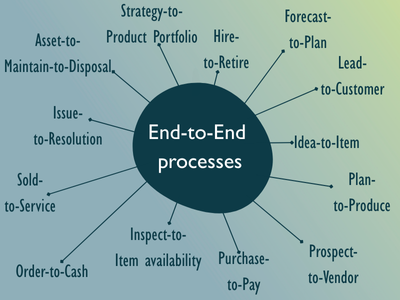
Why map end-to-end processes?
Alongside defining your capabilities, it pays to invest in a thorough end-to-end exercise. Capabilities describe what your organisation must be able to do. End-to-end processes show how different departments, roles and systems work together to get from a concrete trigger to a desired outcome.
Combining both perspectives creates a fuller picture of your organisation and of how strategy is put into practice.
From silo to chain
A process that works well locally isn't automatically optimal for the organisation as a whole. End-to-end analysis makes the impact across the entire chain visible.
Useful insights for the entire organisation
An end-to-end analysis delivers insights that go beyond individual process steps or departments.
You uncover structural problems and bottlenecks
By looking at the entire process chain, waiting times, duplicate registrations, handover issues and inefficient decision points become visible. You investigate not just where a problem becomes visible, but also where it actually originates.
You see the impact of optimisations across the entire chain
An improvement within one department can unintentionally cause extra work, delays or costs for another department. With an end-to-end view, you assess optimisations based on their effect on the entire process, not just the local benefit.
Process communication improves
A shared process view creates a common language. Teams gain a better understanding of how their activities connect with those of their colleagues, and which information is needed at which point. This reduces misunderstandings and makes alignment between business and IT easier.
Responsibilities become clearer
End-to-end processes make visible who is responsible for each step, decision and handover. This makes it quicker to identify where ownership is missing and how departments or team members can collaborate more effectively.
Optimise the chain, not just the step
The best local solution isn't always the best solution for the entire process. End-to-end thinking helps you make choices based on the outcome for the whole organisation and its customers.
A fresh perspective on current and future processes
It isn't always easy for organisations to look objectively at their current processes. Existing ways of working feel like the obvious approach, exceptions have grown historically, and departments often view the process from their own perspective.
An external process analysis helps you recognise patterns, bottlenecks and opportunities more quickly. Thanks to our experience with a wide range of processes and sectors, we identify where needs, risks and improvement opportunities lie, and translate them into a coherent way of working for the future.
Break down silos
End-to-end processes connect departments, roles, systems and data around one shared outcome.